

There is something interesting about speaking to people who are preparing to build businesses. The conversation feels different. You are not speaking to an audience looking for entertainment or inspiration in the traditional sense. You are speaking to people who will eventually have to make decisions, take risks, manage uncertainty and, at some point, discover that reality rarely behaves like the business plans and slides we create for it.
This week I had the opportunity to spend a Friday morning with final-year students from the Faculty of Business at UBB. Originally, the session was supposed to happen in person, but due to some administrative issues, everything moved online. Suddenly, what I had imagined as a lecture hall turned into a Microsoft Teams meeting from my home office at 8:30 in the morning.
Perhaps surprisingly, I did not mind.
There is a certain honesty to online sessions. There are no stages, no lighting, no large room creating artificial energy. Just a screen, a conversation, and people joining from wherever they happen to be that morning. In some ways, it felt closer to a discussion than a lecture, and I suspect that may have worked in our favor.
Going into the session, I knew I wanted to avoid the usual route. Whenever AI enters a room, there is a predictable temptation to immediately start discussing models, architecture, terminology and increasingly complicated explanations about how everything works internally. We are still at a moment where AI discussions often drift toward either science fiction or technical jargon.
I wanted neither.
The audience consisted of future entrepreneurs, not future machine learning engineers. They did not need a two-hour explanation of transformer architectures or discussions about neural network internals. What they needed was something far more useful: context.
More specifically, they needed to understand where AI becomes useful when you are trying to build something real.
One of the more interesting parts of the session happened when we discussed Internet of Behaviors, or IoB. I shared examples from a project where we experimented with understanding how people interact with content and how content itself could evolve based on behavior. In that particular case, article tags, excerpts and patterns of interaction became useful signals that could influence how information is presented over time.
What I found interesting was seeing the realization that AI is not always a chatbot. Sometimes AI is simply understanding behavior. Sometimes it is identifying patterns. Sometimes it quietly sits in the background and improves experiences without announcing itself.
There is a tendency to think of AI as a visible thing. In reality, some of the most useful forms of AI are almost invisible.
Eventually we reached the question that now seems unavoidable whenever AI is discussed. Somebody asked some variation of the same concern I hear almost everywhere:
Will AI take our jobs?
My answer has remained fairly consistent over time.
I do not believe AI itself will take your job. I do, however, think there is a reasonable chance that someone using AI better than you may eventually outperform you.
That distinction sounds small at first, but I suspect it matters enormously.
Throughout history, technology has rarely rewarded the people who resisted tools. It tended to reward people who understood how to integrate them into the way they worked. AI may simply become another chapter in that same story.
The most entertaining moment of the morning probably arrived during the practical demonstrations. Rather than showing endless examples of AI generating text, I wanted to demonstrate something more tangible. We created a one-shot prompt and asked an AI coding agent to build a complete landing page for a fictional premium coffee shop. One prompt. One page. One HTML file. No frameworks. No setup process.
Then we let it work quietly in the background while the session continued.
By the time we returned to it, the result looked surprisingly respectable. Not perfect, of course. Not something ready to immediately launch into production. But certainly much better than many people would expect after a single prompt and a short amount of time.
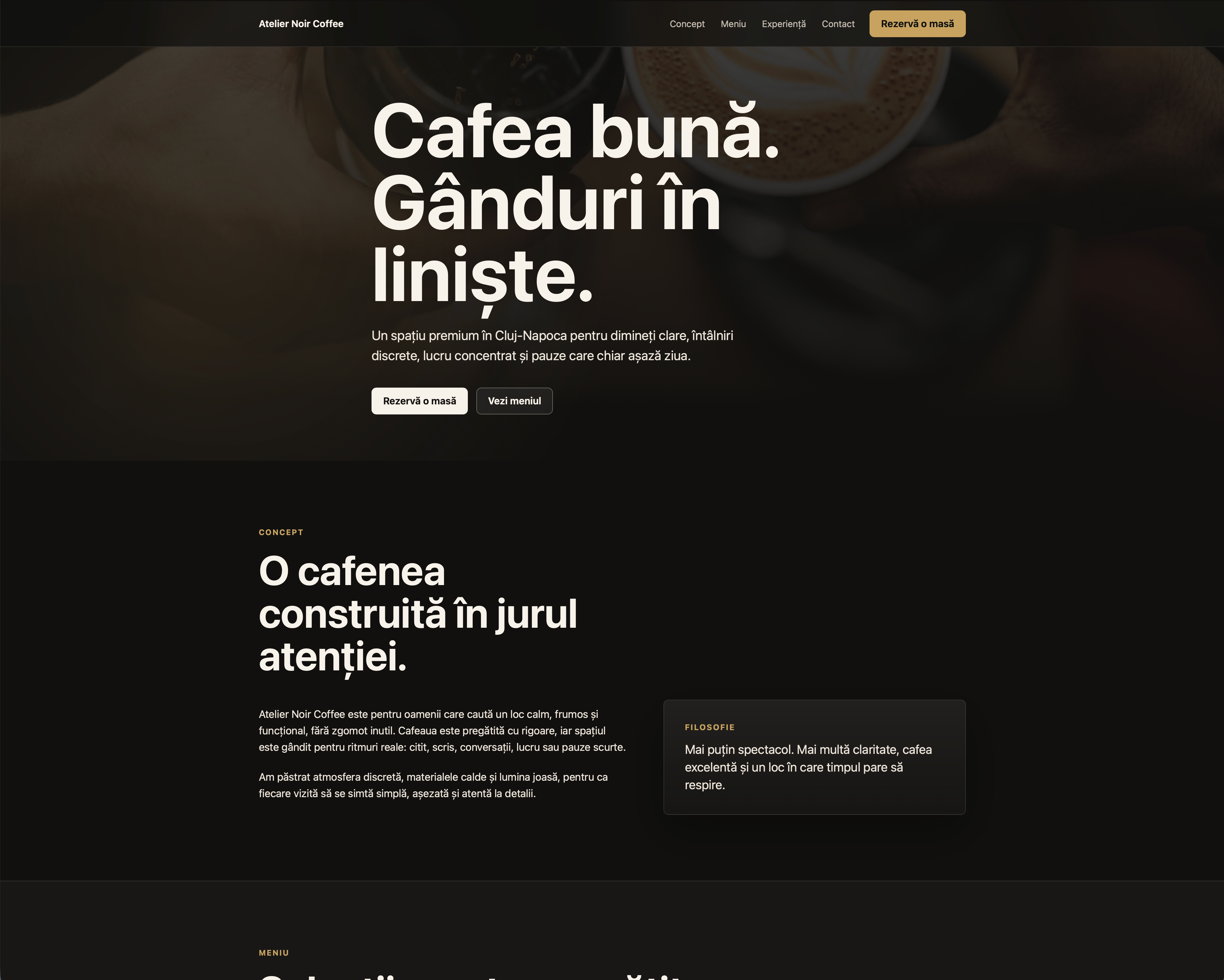
Still, the generated page itself was not really the lesson.
The interesting part was observing what remained unfinished. The AI could create structure, generate ideas and accelerate execution, but it still could not decide what kind of business we wanted to build. It could not define taste. It could not understand subtle positioning decisions. It could not determine whether a message felt authentic or artificial.
The page still required judgment.
And that distinction may be one of the most important lessons future entrepreneurs can learn.
AI can dramatically accelerate execution. It does not eliminate responsibility.
Later, we experimented with prompt engineering and, admittedly, had some fun with it. We gave the model a ridiculous personality prompt instructing it to become rude, sarcastic and generally unhappy about helping us. The responses were entertaining, perhaps more entertaining than they had any right to be on a Friday morning.
But underneath the humor was another lesson hiding in plain sight.
You do not simply receive answers from AI systems. You receive answers shaped by the environment and context you create. Instructions matter. Framing matters. The quality of the question often determines the quality of the outcome.
Entrepreneurship works in surprisingly similar ways.
People often imagine entrepreneurs as people who possess extraordinary answers. Over time, I have become increasingly convinced that what separates many successful founders is not the answers they have, but the questions they learn to ask.
As the session ended after roughly ninety minutes, I found myself thinking less about AI itself and more about the people on the other side of the screen.
The entrepreneurs entering the market over the next decade will probably not compete simply through products, features or access to technology. Those things tend to become available to everyone eventually.
What may become more valuable is clarity. The ability to learn quickly. The ability to think critically. The ability to understand when technology should be used and when it should not.
And perhaps, above all, the ability to ask better questions.
Because sometimes the question itself is worth more than the answer.
And perhaps that was the real lesson from this Friday morning.
AI is not the business. But for people who learn to use it well, it may become a very meaningful advantage.